

Eco-Modulation Explained: Financial and Strategic Benefits for Textile Brands


The textile industry is entering a new era driven by sustainability regulations, evolving consumer expectations, and growing pressure to design longer-lasting products. At the center of this transformation is eco-modulation, a mechanism that can turn eco-design efforts into financial gains.
Eco-modulation is more than a compliance requirement. It is one of the few sustainability tools that directly reward brands for responsible product design. As the French regulatory framework evolves, understanding eco-modulation has become essential for any brand selling textiles in France.
This guide explains how eco-modulation works, why it matters, and how brands can leverage it strategically.
1. Eco-Modulation in Context: EPR and Refashion
Extended Producer Responsibility (EPR) in France requires brands to manage the end-of-life of the textiles they sell, covering collection, sorting, recycling, and the financing of these activities. The idea is simple: the producer pays for the waste they create.
For textiles (including clothing, home textiles, and footwear), EPR responsibilities are managed by Refashion, a government-accredited eco-organization.
Refashion's role goes beyond recycling. It organizes the sector by:
- Managing the EPR system and distributing eco-contributions
- Defining and enforcing eco-modulation criteria
- Monitoring brand compliance and declarations
- Funding innovation and recycling programs
To comply, brands must hold a Unique Identification Number (IDU), submit yearly declarations, pay eco-contributions, display mandatory sorting information, and publish a Prevention and Eco-Design Plan (PPEC).
2. Eco-Contribution: The Mandatory Fee
Every brand placing a textile product on the French market pays an eco-contribution, also known as an eco-fee. This amount varies based on the product type, category, and the volume of products placed on the market. The contribution funds the collection, sorting, recycling, and improvement of the textile system.
Brands must submit their annual declaration and payment by February for the previous year.
For example, brands placing under 100,000 units in a category can receive the maximum eco-modulation bonus, while larger quantities see reduced bonuses.
3. What is Eco-Modulation?
Eco-modulation adjusts the eco-contribution based on product sustainability. Products that are durable, certified, or contain recycled materials earn a bonus, while products that hinder recycling or contain problematic materials incur a penalty.
The mechanism is designed to reward eco-design and encourage more sustainable practices. It also creates direct financial benefits, making sustainability measurable and strategic.
While the concept may sound technical, the principle is simple: better products cost less under the EPR system.
4. The Regulatory Landscape
France has one of the most advanced textile EPR systems in Europe, influencing upcoming regulations across the EU. Key milestones include:
- 2007 – Creation of the textile EPR system
- 2009 – Mandatory application for all producers
- 2020 – Introduction of eco-modulation under the AGEC law
- 2025 – Updated Refashion framework with new criteria
Any brand that places textiles on the French market for the first time, whether sold, donated, or distributed, is considered a producer. This includes e-commerce brands, foreign sellers, private-label retailers, and even charitable organizations.
Brands must declare quantities, pay contributions, and comply with eco-modulation to remain compliant. Failure to do so can result in fines or withdrawal of the IDU.

5. Why Eco-Modulation Matters
Eco-modulation is strategically important for three main reasons:
- Financial Impact – Brands can reduce their REP costs or even earn bonuses that exceed their eco-contribution, creating immediate ROI.
- Strategic Positioning – By linking eco-design with executive decisions, sustainability becomes a value-generating activity, not a cost center.
- Regulatory Alignment – It prepares brands for future French and EU requirements, including fast-fashion restrictions and environmental product disclosures.
For many brands, eco-modulation translates into tens or hundreds of thousands of euros annually, while strengthening compliance and sustainability credentials.
6. How Eco-Modulation Works
Eco-modulation is based on a set of eco-design criteria that either reward or penalize products according to their environmental performance.
Bonuses: rewarding eco-designed products
Eco-modulation bonuses are designed to encourage better product design and are cumulative, meaning a single product can benefit from several bonuses at the same time. Today, the main bonus criteria focus on:
- Product durability, assessed through accredited laboratory tests that demonstrate long-lasting performance
- Environmental certifications, with emphasis on GOTS and other textile labels relevant for fashion brands
- Recycled content, when a proven percentage of recycled fibers is used and supported by traceability documentation

Penalties: discouraging poor recyclability
Eco-modulation also includes penalties (malus) for products that create major barriers to recycling. Currently, the main penalty relates to recyclability issues, particularly for metal–plastic composites or embedded electronics.
This recyclability penalty is not compatible with bonuses, meaning a product subject to a penalty cannot benefit from any eco-modulation bonus, regardless of its other sustainability attributes.
A system that continues to evolve
Eco-modulation is dynamic and evolves alongside regulations and policy discussions. Additional bonuses and penalties are being considered, particularly regarding fast fashion legislation and environmental cost disclosures. These new criteria could be introduced as early as 2026, further strengthening eco-modulation as a key lever for eco-design and regulatory alignment.
7. Practical Steps for Brands
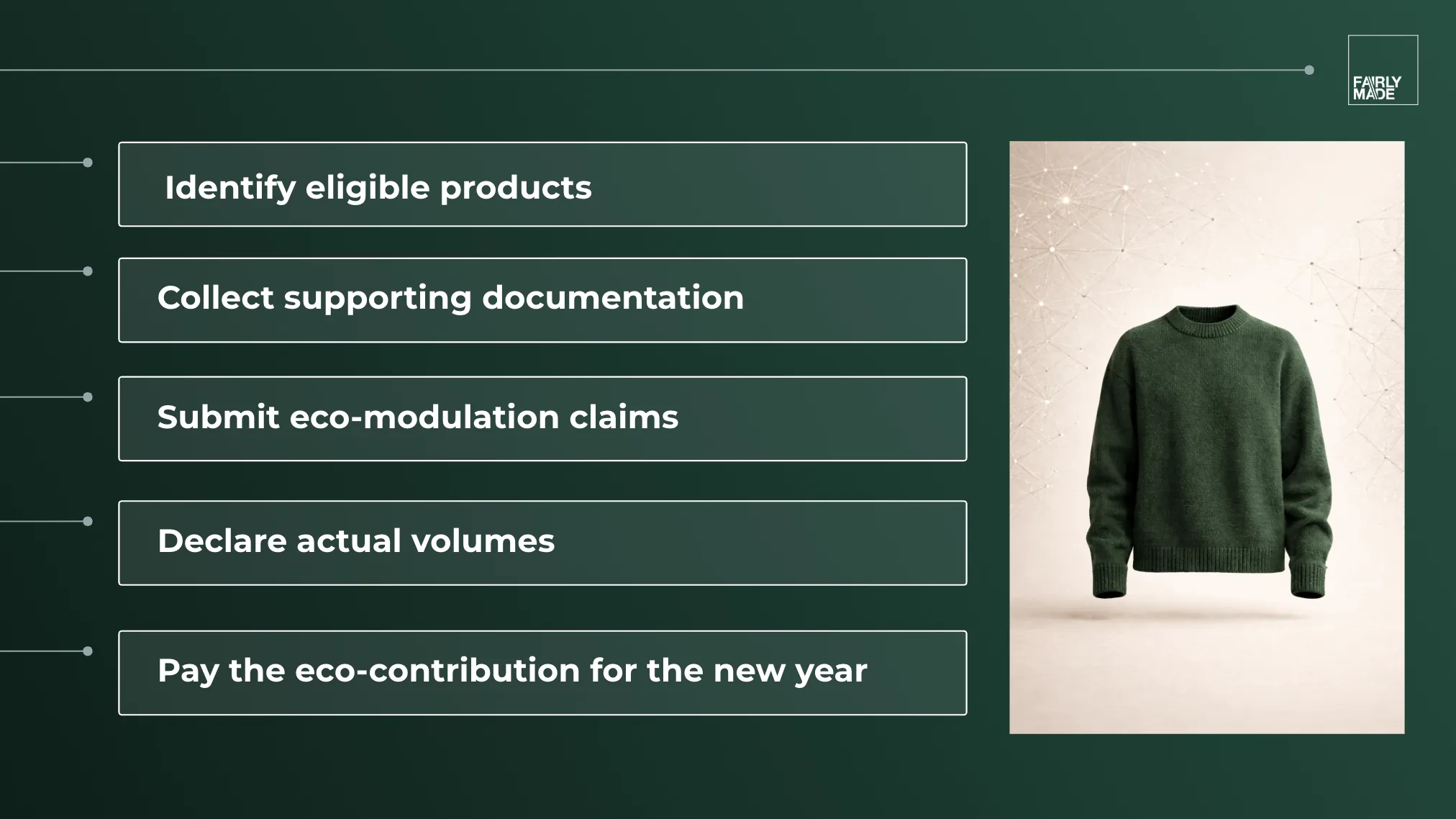
To take full advantage of eco-modulation, brands should:
- Identify eligible products based on durability, certifications, and recycled content
- Collect supporting documentation
- Submit eco-modulation claims before the November 30 deadline
- Declare actual volumes in February of the following year
- Pay the eco-contribution for the new year while benefiting from a reduction applied through eco-modulation bonuses earned on the previous year's products
The reference in Refashion terminology corresponds to a single style or model, which is the unit used for eco-modulation eligibility and reporting.
8. Where Brands Gain
Eco-modulation turns sustainability into a tangible financial advantage. At the end of the cycle, Refashion compares validated references with actual market volumes. Bonuses are cumulative, meaning a single product can receive multiple bonuses, and in some cases, the total bonuses can exceed the eco-fee initially paid.
Penalties are then applied where relevant, and net adjustments are reflected in the following year's eco-contribution. This system creates a direct financial incentive for brands to design more sustainable, durable, and recyclable products, while potentially generating a net financial gain from their eco-design efforts.
Eco-modulation is more than a compliance mechanism. It is a strategic tool that rewards eco-design with financial benefits, drives innovation and product improvement, aligns brands with current and future regulations, and elevates sustainability to an executive-level strategic issue.
For brands selling textiles in France, mastering eco-modulation is essential for profitability, compliance, and long-term competitiveness. Implementing a clear eco-modulation strategy means not only meeting regulatory obligations but also generating measurable returns from sustainability efforts.



.svg)


