

EU Fashion Regulations 2026–2029: Do US Fashion Brands Need to Comply?


In a Nutshell
- Applicability rarely turns on a single criterion. It combines role in the value chain, markets, product categories, composition, headcount and turnover, and the combination differs from one text to the next.
- Two companies of comparable size can therefore carry different obligations, which is why general regulatory overviews do not resolve the question for a specific brand.
- Determining that a text applies is the first half of the exercise. The second is establishing what it requires operationally, and how much of that is already covered by existing product and supply chain data.
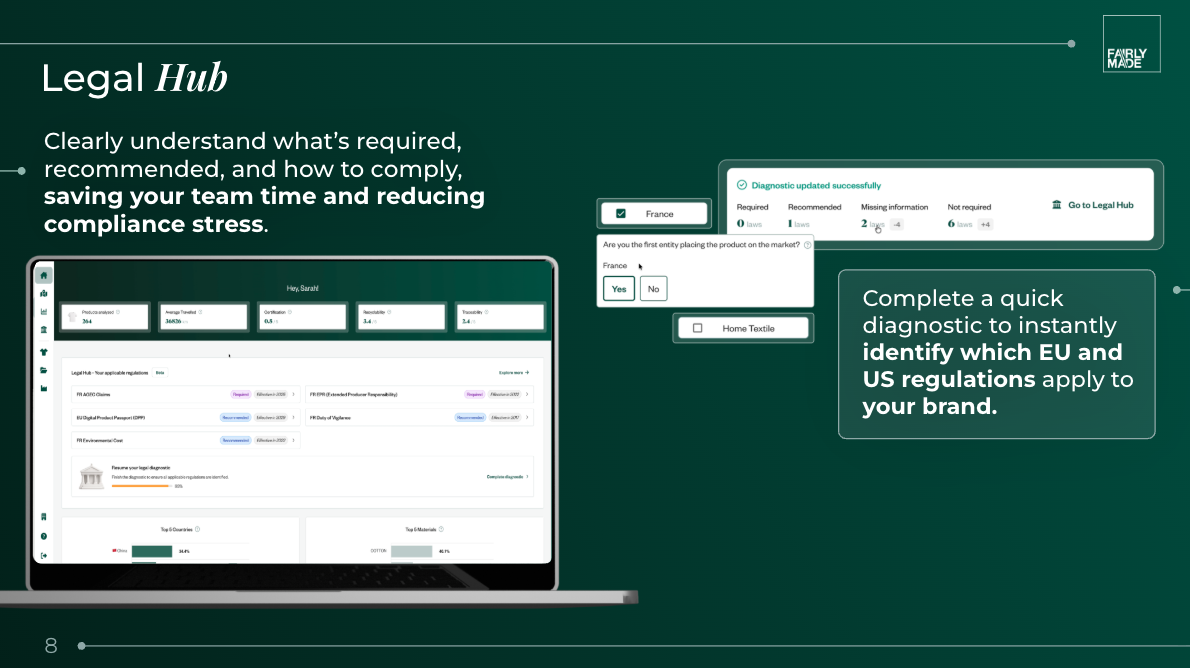
- The Legal Hub covers both: a legal diagnostic that classifies each regulation as required, recommended or not required, and, for each one that applies, the requirements, the risk of non-compliance and the timeline.
The Applicability Question
For fashion brands, 2026 to 2029 is the period in which a decade of regulatory drafting becomes enforceable law. A series of texts adopted over recent years moves into application across the European Union, France and the United States, covering product information, supply chain due diligence, end of life and waste, and environmental claims. Each carries a defined scope, an application date and a penalty regime.
For sustainability and compliance teams, that changes the nature of the work. The subject is no longer which commitments to make and how to communicate them, but which obligations already apply to the company, and from when.
The question comes up constantly and is answered slowly. Whether the deforestation regulation reaches a leather goods line. Whether an environmental cost has to be displayed on the French market. Whether goods entering the United States require documentation on where they were sourced and processed.
Each one requires the same exercise. Locate the scope provisions of the text, extract the thresholds, and test them against headcount, consolidated turnover, turnover by market, product categories, sourcing countries and the company's position in the value chain. Then repeat per text, and again whenever a text is amended.
In most companies the exercise is done once, in a spreadsheet, and is partly out of date within a year. What follows sets out what actually determines applicability, and how the Legal Hub resolves it.
What Determines Applicability
Six variables account for most scope decisions across the texts currently in force or in progressive application.
- Role in the value chain. Brand or manufacturer, importer, distributor, online seller, marketplace, raw material supplier.
- Market of availability and market of entry. Two distinct criteria. Some texts attach to where products are made available to the end customer, others to where goods or raw materials physically enter the market. Selling into a market through a distributor is not the same position as importing into it.
- Establishment. Registered office in the EU or EEA, headquarters in France, commercial activity in the EU, a subsidiary or branch in the bloc.
- Product category. Ready-to-wear, shoes, apparel accessories, home textile, packaging, furniture, toys, electrical products, sporting goods. The lists are not aligned across texts, so a category in scope for one is not necessarily in scope for another.
- Composition and sourcing. Bovine leather, wood and natural rubber entering the EU are EUDR commodities. Sourcing or processing in China creates UFLPA exposure. Composition operates as a scope criterion, not only as an input to life cycle assessment.
- Size, in the applicable unit. Headcount, consolidated turnover, turnover generated in a given market, or units placed on a given market.
These criteria rarely operate on their own. Most texts require several of them to hold at once, and the required combination differs from one text to the next. A single variable, company size in particular, is almost never sufficient to conclude.
That is what makes the question difficult to settle internally: not whether a regulation exists, but whether the specific combination it defines matches a given brand, and from which date.
What the Legal Hub Does
The Fairly Made Legal Hub opens on a legal diagnostic of around twenty questions about the company rather than about the texts: role in the value chain, markets of availability and of entry, product categories, whether EU imports contain bovine leather, wood or natural rubber, headcount, consolidated turnover, turnover by market, group structure.
Results recalculate as answers are entered, and the form does not need to be completed in one pass. Partial input returns partial results, refined as information is added.
Each regulation is returned in one of four states:
- Required. Applicability criteria met.
- Recommended. Thresholds approached, or the text is in progressive application and preparation is advisable ahead of full application.
- Not required. Criteria not met.
- Missing information. At least one input is outstanding.
Regulations Covered
Ten texts:
- France: AGEC Claims, EPR, Environmental Cost, Duty of Vigilance
- EU: Digital Product Passport (ESPR), Deforestation Regulation (EUDR), Sustainability Reporting (CSRD), Corporate Due Diligence (CSDDD)
- US: Forced Labor (UFLPA), Californian Textile EPR (SB 707)
Each is held with its own timeline: adoption, progressive application, full application.
The perimeter is bounded and extended as texts are adopted or amended. Applicability rules are maintained in the product, so results reflect the current state of the texts covered rather than their state when the form was first filled.
The wider 2026 landscape, text by text, is covered separately here: How fashion brands can prepare for 2026 sustainability and transparency regulations. Our full set of regulatory explainers sits in the Legal Hub resources library.
For primary sources, the European Commission publishes its EUDR implementation guidance.

What You See for a Regulation That Applies
A positive applicability result does not indicate what has to be done, or in what sequence.
Opening a regulation returns a summary of the text in plain language, a link to the full article, and the level at which it applies. AGEC claims apply at product level, which already determines whether the work sits primarily with the product team or with legal and finance.
Two tabs follow.
Requirements sets out what has to be done, grouped as the work divides: scope and governance, product scope and categorisation, product environmental data, data management and consumer disclosure, claims control, training. Each item is marked required or recommended.
“About this regulation” covers three points.
- Why am I concerned. The diagnostic answers that produced the result, each shown with the value given: regions of availability, role in the value chain, product categories, whether the company is the first entity placing products on the market, units placed on the market, consolidated turnover, turnover in the covered categories. Where an answer has since changed, it can be updated from there.
- Risk of non-compliance. Reputational exposure, financial exposure with the applicable levels, and the corrective actions a regulator can impose.
- Timeline. Adoption, amendments and progressive entry into application.
That structure is what turns an applicability result into a plan: what has to be done, how exposed the company is if it is not, and by when.
Progress Tracking
Obligations describe the target state. Tracking describes the gap.
Compliance progress is held at product level: products with AGEC countries identified, products with raw material origin, products approaching a deadline while still non-compliant, days remaining.
Two views, for two different constraints:
- Product view, for collection preparation and identification of blocking points.
- Supplier view, for the upstream constraint: response status, incomplete components per supplier, reminders sent and their dates, direct contact.
On most compliance programmes the elapsed time sits in this collection phase rather than in interpretation, which is why supplier engagement tends to determine whether a deadline is met.
Sequence
- Complete the diagnostic, leaving outstanding inputs blank.
- Work through required, then recommended, then missing information. Outstanding inputs are generally resolvable internally.
- Open the applicable texts and map their obligations against existing data.
- Assess data readiness against application dates. Most obligations resolve into supply chain traceability requirements, which are collected over months.
The volume of applicable regulation is not going to fall between now and 2029. Determining which part of it applies to a given company, and what it requires, is a bounded exercise and worth treating as one.


.svg)


