
What the Best Digital Product Passport Solution Actually Has to Do


A Digital Product Passport has two distinct layers. One is the passport itself: a defined set of data fields, a unique identifier registered centrally with the EU, and a data carrier that resolves to them. The other is the evidence behind each field, which comes from the supply chain and accumulates over months rather than weeks. Both layers are necessary, and vendors specialise in different parts of them, which is why two platforms can look very similar in a demo and suit quite different situations.
Evaluating the best Digital Product Passport solution therefore starts with working out which layer your project actually depends on, then testing four things that sit behind the interface. Below is each one, why it tends to decide how a project goes, and the question that produces a straight answer in a demo.
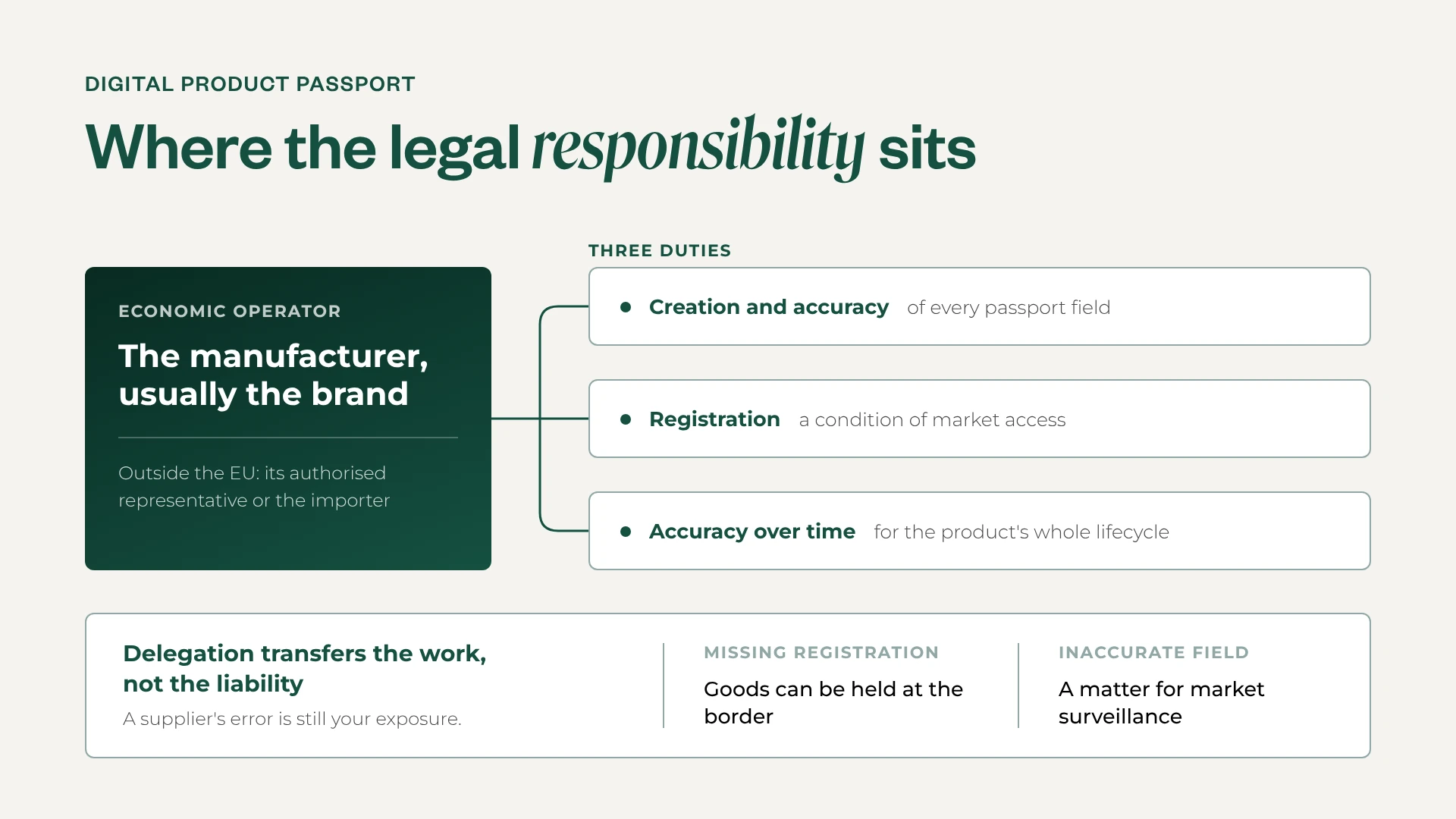
Where the legal responsibility actually sits
The ESPR assigns the passport to the economic operator placing the product on the EU market: the manufacturer, usually the brand. Where the manufacturer is established outside the EU, its authorised representative or the importer. The Commission's guidance for economic operators is unambiguous on three points. Creation and accuracy sit with that operator. Registration is a condition of market access, not an administrative follow-up. And the duty to keep the information accurate runs for the product's lifecycle rather than ending at publication.
The architecture reinforces it. The EU Registry holds identifiers and pointers; the product data itself stays with the operator or with a service provider acting on its behalf. The regulation creates that service-provider role explicitly, which means delegation transfers the work and not the liability.
Two implications follow for procurement.
A supplier's error is still your exposure. If a supplier declares a composition or a certification incorrectly, you can pursue it contractually, but the regulatory responsibility stays with you. Evidence quality upstream is therefore a compliance question, not a sustainability one.
And enforcement can arrive early. A missing registration can show up as goods held at the border; an inaccurate field is a matter for market surveillance authorities.
Read that way, the four criteria below stop being features and become questions about exposure. Can you substantiate what the passport says? Can you still substantiate it in eighteen months, once the supplier has changed?
1. It reaches the tiers you have no contract with
The hard boundary in supply chain data falls where commercial leverage runs out, which is rarely where the tier numbering suggests. An assembly supplier responds because you pay them. The spinner three steps upstream has no such incentive and no account manager whose performance depends on replying to you.
This is where passport projects stall, which makes the collection model more decisive than the software. A self-service portal assumes someone internally will chase non-responders, in their language, across time zones, for months; that cost is real and absent from every quote. A managed model carries a higher price and absorbs the work. A brand with forty stable suppliers rarely needs it. A brand with several hundred suppliers usually does.
Two further checks. Whether suppliers can work in their own language, since response rates track language far more closely than most teams expect. And whether subcontractors surface at all: a tier 2 supplier who outsources dyeing creates a gap that tier-based mapping will never reveal, and dyeing is frequently the largest single contributor to a garment's water and chemical impact.
Ask in the demo: show me a traceability tree where a subcontractor appears that the brand did not know about.
2. It checks certificates against what they actually cover
Collecting certificates is standard across the market. Verifying that a certificate covers the shipment it has been attached to is a separate capability, and the lack of it is the most common weak point when a sustainability claim is challenged.
The distinction that matters: a scope certificate attests that a facility is certified to a standard. A transaction certificate attests that a specific shipment was produced under it. Brands routinely hold the first and treat it as proof of the second. If you claim a garment is GOTS organic cotton, the scope certificate establishes that your mill is capable of producing it; only the transaction certificate establishes that your fabric did.
A credible tool knows which standards carry a transaction certificate requirement and requests them automatically when they apply, rather than leaving a team to work out that GOTS, GRS, RCS and RWS require one while most social audit schemes do not. It should also surface expiry dates clearly and explain why a document failed validation instead of silently storing it.
Ask in the demo: show me what happens when a supplier uploads an expired certificate.
3. It tracks a rulebook that is still being written
The textile passport is being bought against rules that do not yet exist in final form. The delegated act that sets the data requirements for apparel is expected in late 2027. The technical standards underneath it arrived more recently still: the eight DPP standards developed by CEN/CENELEC JTC 24 under mandate M/604 were published in 2026, and they define how passport data is identified, structured and accessed.
This has a practical consequence that is easy to miss during procurement. Any platform bought today will have to change, possibly substantially, before the first mandatory passport is issued. What separates vendors is not whether they have a roadmap slide, but whether they are reading the drafts as they are written or waiting for the summary afterwards.
That is an argument for starting now rather than waiting. The architecture is already knowable: the ESPR sets out the categories of information a passport must carry, the CEN/CENELEC standards define how that data is identified, structured and accessed, and the Registry is operating. What the delegated act will add is the final field list for textiles. A brand that waits for it still faces the same twelve to eighteen months afterwards, and very little of that time is software configuration. Most of it is change management: identifying who inside each supplier actually holds the data, explaining what is being asked and why it is being asked, and training people who have never been requested to report a dyeing process or an energy source before. Suppliers are fielding these requests from several customers at once, in different formats, and the ones who understand the request respond while the ones who do not go quiet. A brand that starts now has that groundwork behind it and only fields to populate when the act lands.
Two things are worth checking. Whether the vendor sits in the bodies producing the rules, since standards work is open to participants and closed to everyone else until publication. And whether regulatory interpretation is done in-house or outsourced, because a tool built on a consultancy's reading of a draft inherits that reading, including its errors.
Ask in the demo: what do you already know a DPP will require, and what have you built so that a passport issued today can absorb the final requirements rather than being rebuilt?
4. It keeps passports current at catalogue scale
A passport has a lifespan. It sits printed on a garment that will be in a shop for months, pointing at a record registered in a system the EU has already brought online: the DPP Registry went live on 20 July 2026, with a testing environment alongside it.
Things change after launch. A supplier is replaced, a composition corrected, a score recalculated on better data. Each change has to propagate to every passport it affects, including those already scanning in store. Handled one product at a time, a single collection becomes weeks of work; handled inconsistently, two garments from the same drop tell different stories to the same customer.
What to look for: whether a correction made once propagates automatically to the forms and traceability trees that depend on it, or has to be repeated in several places. And whether hundreds of passports can be refreshed in one operation, with progress visible per product and explicit errors where something needs attention.
Ask in the demo: a supplier changes mid-season. Walk me through what happens to 400 live passports.
Where Fairly Made fits
Our team runs the supplier data collection, through a supplier platform available in six languages, with 120+ brands globally and 35,000 suppliers already onboarded. Certification evidence is collected and checked alongside the supply chain data, rather than left for the brand to assemble, and our collaboration with Control Union, one of the leading certification bodies for GOTS, GRS, OCS and RCS, is building toward verification drawn directly from the certifier's own records rather than from the document alone.
Our regulatory work is done in-house and in the rooms where the rules are set: the CIRPASS-2 textile working group, the GS1 DPP community of interest, CEN/CENELEC and AFNOR on DPP architecture. That work feeds our Legal Hub, where brands can identify which regulations apply to them and find the resources attached to each, and our in-house regulatory expertise feeds the answers our teams give clients, which matters when a rulebook is still moving.
The passports brands issue through us today are built on that reading of the regulation and designed to be enriched as the delegated act specifies the final content, so the work done now is preparation rather than a draft to be redone. Passports refresh hundreds at a time, and a single correction propagates everywhere it applies.

Comply with the latest regulations